

Whatever the API format, Apiome probably supports it.
Every format is an adapter in the same registry, so anything you import can be transcoded to any of 53 export targets.
REST & HTTP
OpenAPI 3.2 / 3.1 / 3.0, Swagger 2.0 / 1.2, RAML, API Blueprint, TypeSpec, WADL, WSDL / SOAP, OData, Google API Discovery, Arazzo workflows, Postman collections, and .http / .rest files and cURL commands.
Events & Streaming
AsyncAPI 2.x / 3.x, CloudEvents, Kafka Connect schemas, and Avro and Protobuf message schemas.
Graph & RPC
GraphQL — SDL or live introspection — plus gRPC / Protocol Buffers (proto2, proto3, and editions) from .proto files or server reflection, Connect RPC, Apache Thrift, Smithy, OpenRPC, Cap'n Proto, CORBA IDL, ONC RPC, XML-RPC, and WebAssembly WIT.
Schemas & Data Contracts
JSON Schema, JSON Type Definition, XSD, DTD, RELAX NG, ASN.1, CDDL, Avro, FlatBuffers, Apache Arrow, SQL DDL, dbt models, and ODCS data contracts — scored on their own terms and transcoded to any other target.
Cloud, Gateways & AI
Kubernetes CustomResourceDefinitions, Gateway API HTTPRoutes, Kong, AWS API Gateway, Azure API Management, Apigee and reverse-proxy configs, LLM function-calling tool schemas, MCP server manifests, and live MCP server endpoints.
Regulated & Mainframe
FHIR, HL7 v2 and v3 / CDA, DICOM, NCPDP, ISO 20022, ISO 8583, SWIFT MT, FIX, EDI X12, EDIFACT, SAP IDoc, NACHA, COBOL copybooks, PL/I, IMS, VSAM, and z/OS Connect.
New adapters ship continuously, with 40+ more queued across gateways, code-first types, client workspaces, EDI, IoT, and mainframe standards.
See every supported formatEverything you need to build better APIs
From the first schema to the published SDK, one workspace carries the contract.
API Catalog
Bring every API into one Catalog — from a file, URL, clipboard, Git repository, SwaggerHub, Postman, a live MCP endpoint, or AI — across 97 formats: REST, AsyncAPI, GraphQL, gRPC, gateway configs, data contracts, EDI, IoT, mainframe and more. Preview the inventory and lint grade of every import before anything is written.
Convert to Projects
Turn any catalog item into an OpenAPI project with one conversion, keeping a record of what was carried over, inferred, or dropped along the way.
Visual Schema Canvas
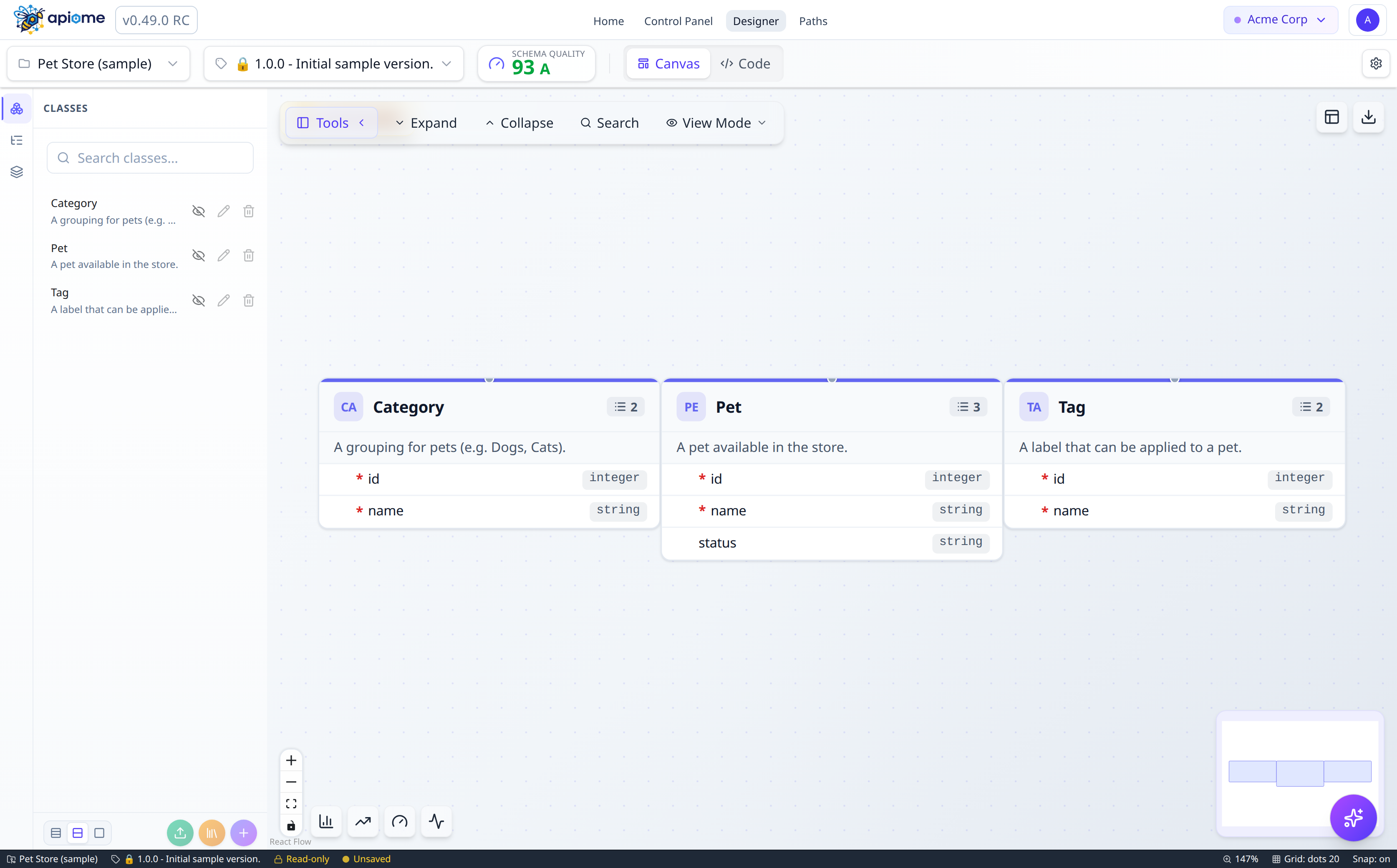
Design data models on an interactive canvas with drag-and-drop, smart auto-layout, color-coded groups, animated edges, and 10+ themes.
Paths Designer
Author API endpoints visually with HTTP method color coding, parameter editing, response schema binding, and real-time OpenAPI validation.
Versions & Publishing
Full version history with side-by-side comparison and every change classified as breaking, non-breaking, or docs-only. Publish, unpublish, freeze, tag, and plan each version's sunset on a timeline.
Export to 53 Formats
Export any version to OpenAPI, Protobuf, GraphQL, AsyncAPI and 49 more formats, plus canvas exports to PNG, SVG, PDF, Mermaid, and PlantUML.
Lint & Quality Scores
Every import and version is linted and graded A to F, with ranked findings and a workspace-wide lint posture that shows where to start.
AI-Powered Design
Describe your API in plain English and let AI generate a complete OpenAPI specification. Quality scoring grades your spec from A to F.
Reviews & Comments
Comment threads anchored to classes, paths, and operations, review rounds where reviewers approve or request changes, and an in-app notification inbox.
Roles & Access Control
Granular RBAC with built-in Owner, Admin, Editor, and Viewer roles, a tunable permission matrix, member lifecycle controls, and API keys.
Secure Sign-Up & Sign-In
Sign up with email or GitHub, Google, Microsoft and other providers, secure the account with an authenticator app, and require two-factor for a whole workspace.
Multi-Tenant Workspaces
Organize projects in isolated workspaces with per-workspace members and roles, and a separate platform-admin plane for operators.
One-Line CLI
Install the apiome CLI with one line, sign it in through your browser with apiome login, and manage projects, versions, and tags from the terminal or CI.
Public API Browser
Publish specifications to a public portal with Monaco-powered viewers, version comparison, and embeddable snippets — or browse community designs.
Coming soon
Built, and held back from RC6 while Catalog and Projects are finished first. RC7 is in progress with Catalog and Project improvements; the rest arrive in later releases.
Export Studio
Rank export targets by readiness, inspect an artifact through a source-to-target mapping graph, export several targets or a whole batch at once, and push gateway configs back.
SDK Generation
TypeScript, Python and dependency-free Go clients from the published contract, branded and published to npm and PyPI or delivered as a pull request, regenerated on every publish.
MCP Servers & Agent Access
Catalog third-party MCP servers with A–F grades and trust scans, and turn a published version into a governed agent toolset with scoped agent keys and usage analytics.
Custom Style Guides
Spectral-compatible rule sets per workspace that gate publishing on violations, plus approval policies that require reviewers before a version can publish.
Access Audit Log
Every privileged action in an append-only, hash-chained ledger, exportable to JSON or CSV for compliance.
Gateway & Registry Connectors
Keep the Catalog in sync with Kong, AWS API Gateway, Azure API Management, Apigee and agent or schema registries, refreshed on a schedule.
Shadow API Report
Find the routes your gateways serve that no catalog spec describes, and adopt or dismiss each one.
Dependency Graph & Blast Radius
See which APIs depend on which, from declared and runtime evidence, and what a change would reach before you ship it.
Teams & Ownership
Give every API an owning team, route findings to its owners, and stop a version with no owner from publishing.
Schema Registry
Mirror Confluent-compatible schema-registry subjects into the Catalog, with every schema version and its compatibility mode.
Primitives & Types
A shared registry of reusable types and primitives, defined once and used across every project in a workspace.
Agents, Models & Components
Catalog AI agents, models and software components beside your APIs, with scorecard facts and Backstage and Compass import.
Consumer Contracts
Register who consumes each API, and see exactly which consumers a breaking change would break.
From first sketch to shipped contract
Four steps, one workspace. Each stage reads from the same model, so nothing drifts between the canvas, the spec, and what your consumers receive.
- 01
Bring in or design
Import existing specs into the Catalog and convert them to projects — or drag classes onto the canvas, define properties and types, and draw relationships.
- 02
Author paths
Switch to the Paths Designer to create endpoints, bind schemas to request bodies and responses, and configure security.
- 03
Validate & score
Run real-time OpenAPI validation, review quality scores from A to F, and test schemas against real payloads in the Schema Test Bench before exporting.
- 04
Publish & ship
Publish a version to the public browser with a hosted mock for your consumers, export it to any of 53 formats, and plan its sunset when the next one ships.
Explore public OpenAPI specifications
Discover and learn from publicly available specifications shared by the community. Browse real-world API designs, get inspiration for your projects, and see how others structure their APIs.
- Browse hundreds of public API specifications
- View detailed endpoint documentation and schemas
- Learn best practices from community-shared designs
- Share your own APIs with the community
- Get generated SDKs and runnable code examples where publishers enable them
