Visual Schema Designer
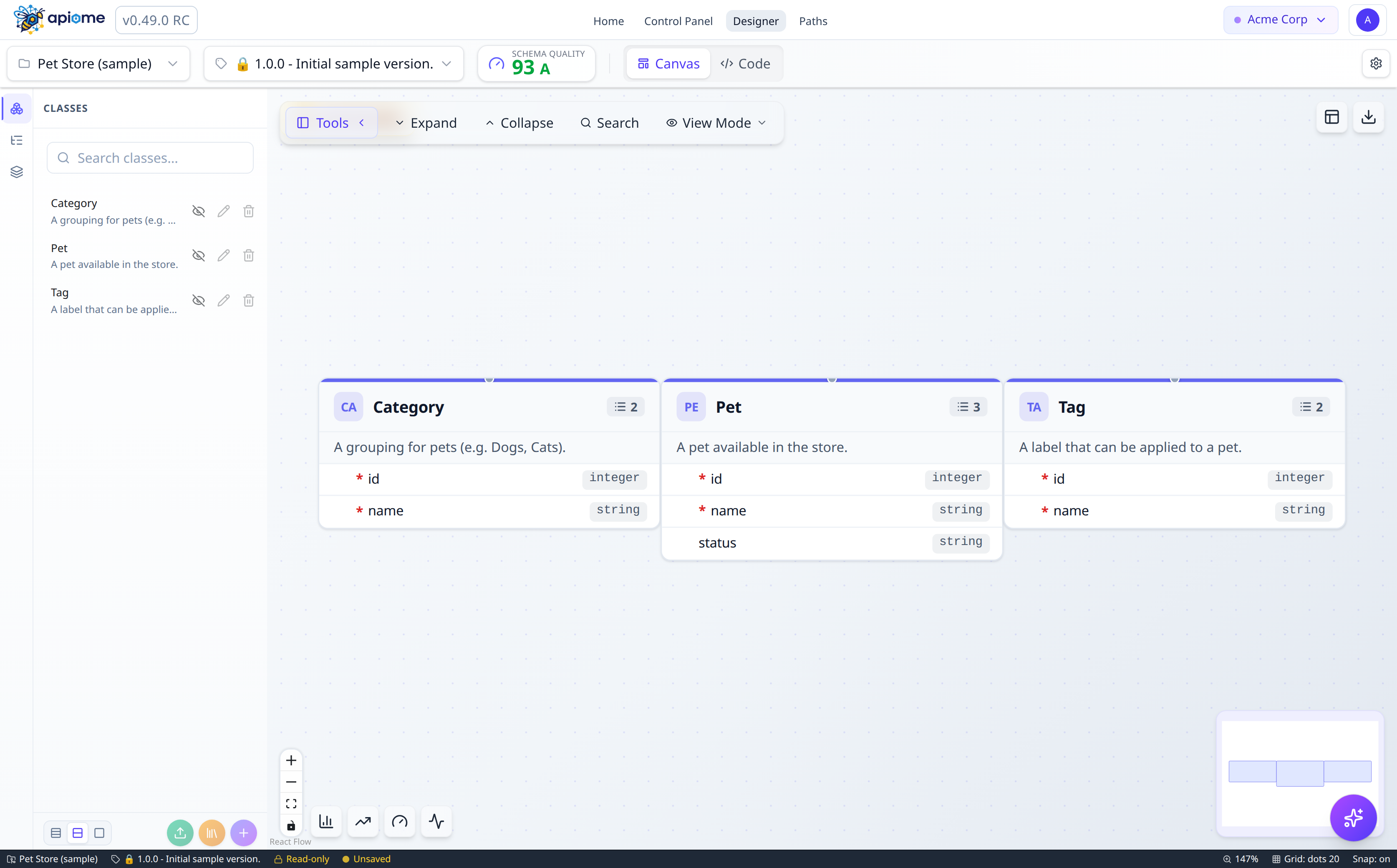
Design data models on an interactive canvas with drag-and-drop simplicity. See relationships, constraints, and dependencies at a glance — no YAML editing required.
- Drag-and-drop class creation with property editors
- Smart auto-layout algorithms
- Color-coded groups with collapsible containers
- Real-time relationship visualization with animated edges
- Version comparison with side-by-side diff highlighting
- 10+ canvas themes including dark mode and blueprint
- Canvas export to PNG, SVG, PDF, Mermaid, PlantUML, and more
- Quality scoring with completeness and consistency grades
Visual API Path Authoring
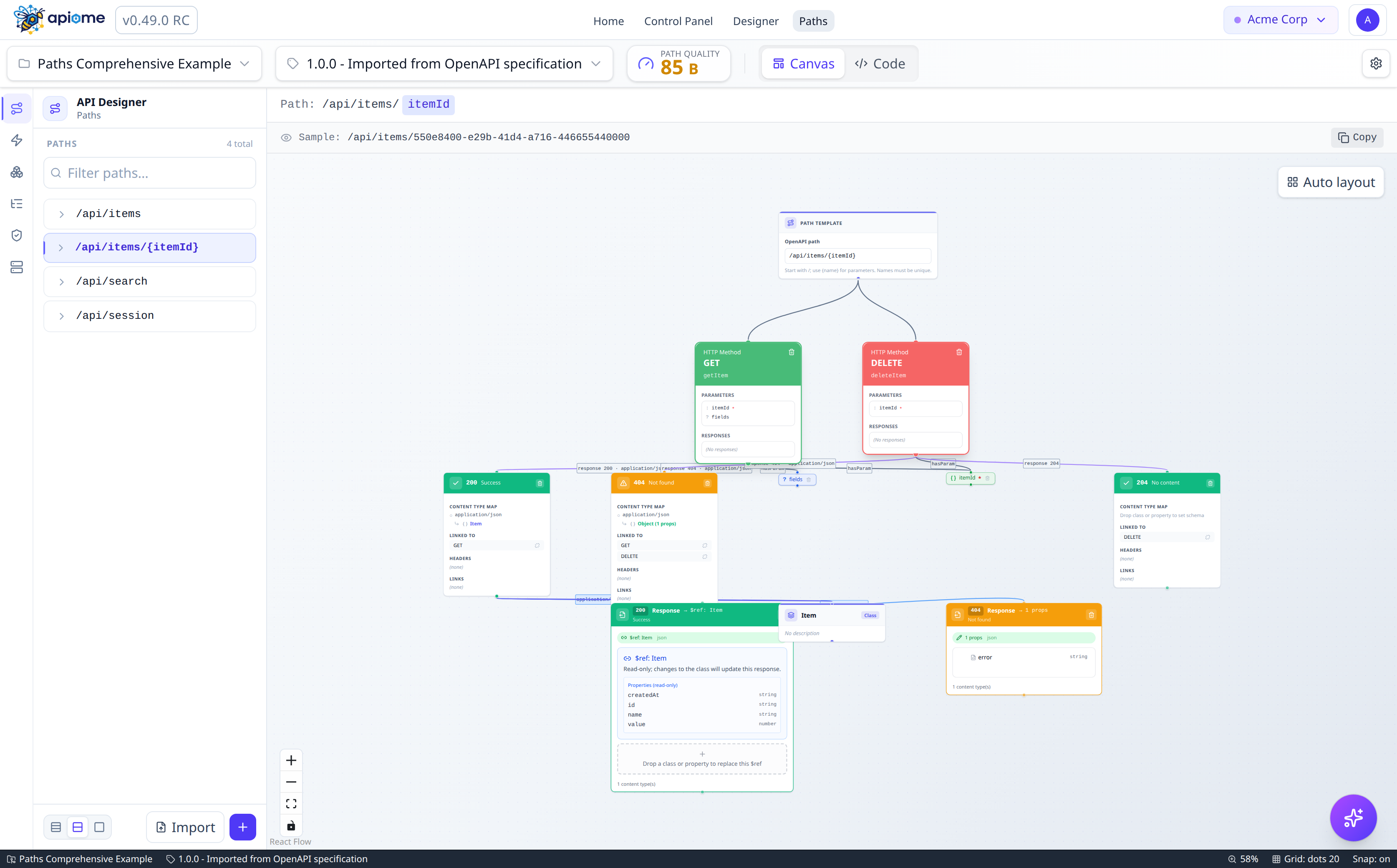
Design every endpoint visually — operations, parameters, request bodies, responses, and security schemes — all on a dedicated developer-focused canvas with HTTP method color coding and real-time OpenAPI validation.
- HTTP method nodes with GET, POST, PUT, PATCH, DELETE color coding
- Drag-and-drop parameters, responses, and schema bindings
- Multi-content-type support (JSON, XML, multipart/form-data)
- Inline schema editing with class reference ($ref) binding
- Response status code color bands (2xx, 3xx, 4xx, 5xx)
- Security scheme configuration (API Key, Bearer, OAuth2)
- Smart edge routing with animated data flow visualization
- Auto-generate CRUD operations from existing schemas
Import almost anything from Anywhere
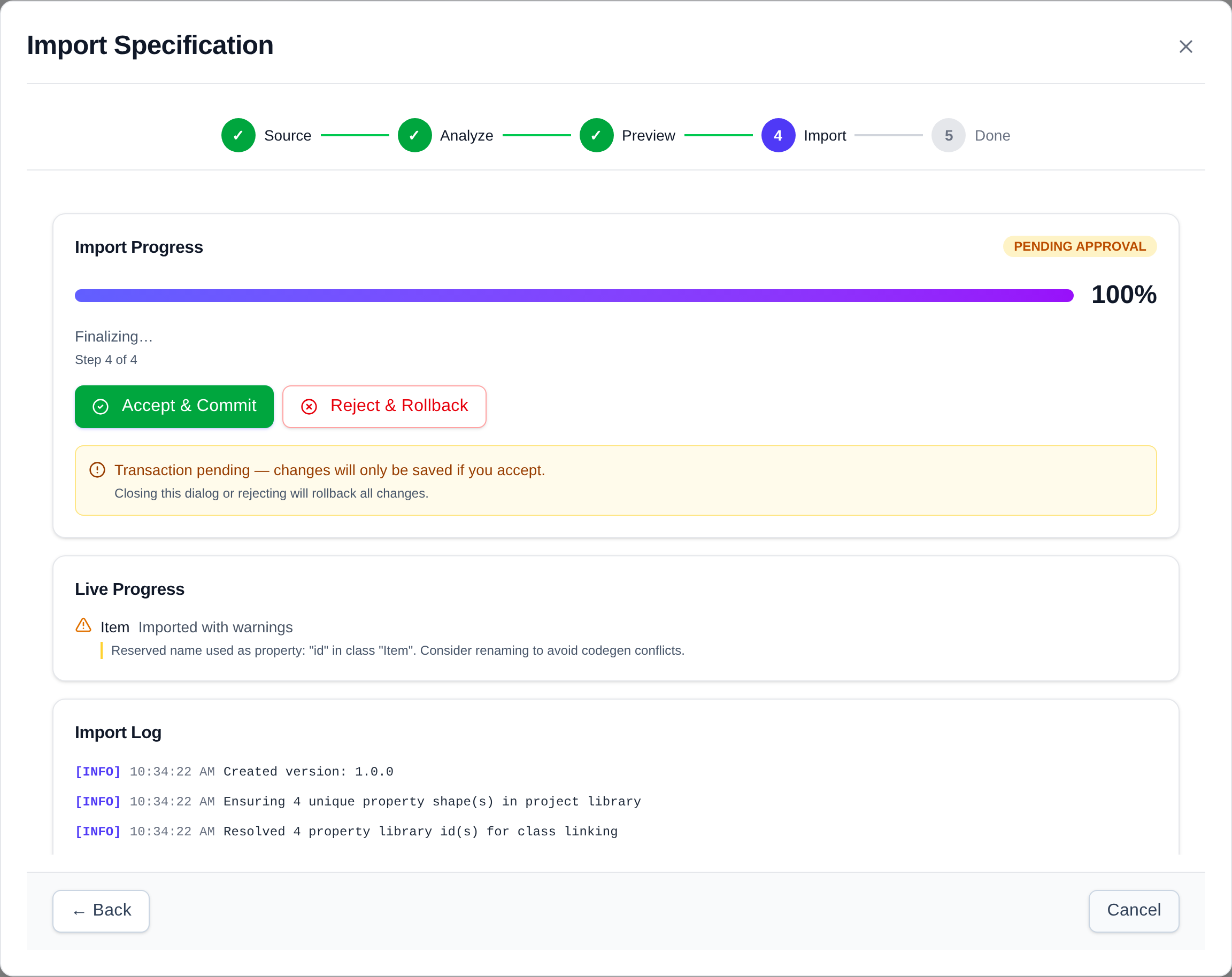
Bring your existing API specifications into Apiome with a guided, multi-step import wizard. Pull from file upload, URL fetch, clipboard paste, Git cloning, SwaggerHub, Postman collections, live MCP servers, or AI-generated specs — spanning REST, event-driven, GraphQL, and gRPC APIs — and see exactly what an import will create, with a lint grade and ranked findings, before anything is written.
- OpenAPI 3.1 / 3.0, Swagger 2.0, JSON Schema, AsyncAPI, GraphQL, and gRPC / Protobuf
- Google API Discovery, Kubernetes CRDs, LLM tool schemas, and .http / cURL request files
- Pre-commit preview: full entity inventory with a source-to-catalog projection graph
- Re-import deltas against the current revision — including an explicit no-op verdict
- Pre-flight quality gate with A–F grade, ranked findings, and tenant policies with waivers
- Git import from GitHub, GitLab, and Bitbucket with branch selection
- SwaggerHub, Postman v2.1 collections, MCP server discovery, and AI-powered import
- Same pre-flight verdicts from the CLI with non-zero exit codes, so CI can gate on them
Every source, one catalog
Bring in APIs however they live today — from a file on disk to a running server — across every major paradigm. The wizard detects, normalizes, previews, scores, and quality-gates each one before a single byte is written to your catalog.
Where you import from
File Upload
Drop or browse for a spec file
URL Fetch
Pull a spec straight from a URL
Clipboard Paste
Paste raw JSON or YAML content
Git Repository
GitHub, GitLab, Bitbucket + branches
SwaggerHub
Public and private SwaggerHub APIs
Postman Collection
Import Postman v2.1 collections
MCP Server
Discover a live MCP endpoint
AI Generation
Describe your API in plain English
What you can import
OpenAPI 3.1 / 3.0
REST APIs — the modern OpenAPI standard
Swagger 2.0
Legacy REST API descriptions
JSON Schema
Standalone data-model schemas
AsyncAPI 2.x / 3.x
Event-driven and streaming APIs
GraphQL
SDL or live endpoint introspection
gRPC / Protobuf
.proto files or server reflection
Google API Discovery
Discovery documents for Google-style REST APIs
Kubernetes CRDs
CustomResourceDefinition structural schemas
LLM Tool Schemas
Function-calling tool bundles from AI agents
HTTP Request Files
.http / .rest files and cURL commands
30+ More Formats
RAML, Smithy, WSDL, Avro, Thrift, CloudEvents, and more enterprise and mainframe formats
Complete platform capabilities
Every tool you need to design, validate, export, and collaborate on APIs — in one place.
Interactive Canvas
Drag-and-drop schema design with smart auto-layout, grid snapping, minimap navigation, and zoom controls.
Paths Designer
Visual endpoint authoring with HTTP method color coding, parameter editing, and response schema binding.
Multi-Source Import
Import from file, URL, clipboard, Git, SwaggerHub, Postman, MCP servers, or AI — and preview the full inventory of what an import will create before anything is written.
Pre-Flight Quality Gates
Every import and export candidate is linted and graded before it commits — with ranked findings, tenant-configurable policies and waivers, and matching CLI exit codes for CI.
Schema Test Bench
Validate real payloads against any schema with path-anchored errors, generate valid samples and deliberately invalid mutants, and prove a spec’s own examples conform.
Multi-Tenant Architecture
Organize projects by teams and organizations with granular permission controls and isolated workspaces.
Version Control
Full version history with side-by-side comparison, diff highlighting, and semantic change tracking.
Any-to-Any Transcoding
Import 39 API formats and emit 35 — OpenAPI to Protobuf, GraphQL to JSON Schema — with per-entity fidelity evidence for everything retained, inferred, or dropped.
10+ Canvas Themes
Light, dark, high contrast, blueprint, whiteboard, solarized, nord, and more — switch instantly.
Relationship Visualization
Animated edges with smart routing, cardinality labels, and constraint badges for clear data flow.
Rich Export Options
Export Studio ranks targets by readiness, previews artifacts structurally with a source-to-target mapping graph, and exports canvases to PNG, SVG, PDF, Mermaid, PlantUML, GraphML, DOT, or raw JSON.
Canvas Search
Find any class or property instantly with Cmd+F search, regex support, and result highlighting.
Granular RBAC
Built-in Owner, Admin, Editor, and Viewer roles per workspace, with a resource-by-action permission matrix you can tune to your team.
Member Lifecycle
Invite, suspend, and offboard members with status-aware access — suspended members are denied tenant access immediately.
Tamper-Evident Audit Log
Every privileged action is recorded to an append-only, hash-chained access ledger, exportable to JSON or CSV for compliance.
SSO & Platform Admin
OAuth sign-in via GitHub, GitLab, Azure AD, Google, and Okta with TOTP and email 2FA — plus a platform-administration plane kept separate from tenant administration.
API Security Schemes
Configure OAuth2, API Key, Bearer token, and OpenID Connect security directly on operations.
AI-Powered Import
Describe your API in plain English and let AI generate a complete OpenAPI specification for you.
Multi-Axis Quality Scoring
Automated A–F grades across quality, protocol, security, supply-chain, supportability, and compatibility axes — with the same score served to UI, CLI, and REST.
Developer Portal & Try-It
Publish versions to a public portal with full-text search, side-by-side version diffs, and a live Try-It console with auth helpers and generated code snippets.
Drag-and-Drop Everything
Operations, classes, properties, and schemas can all be dragged from the sidebar directly onto the canvas.
Level of Detail
Nodes simplify automatically when zoomed out, showing only class names for a clean bird's-eye view.
Schema Analytics
Track total classes, properties, relationships, and complexity metrics across your entire project.
Hosted Mock Servers
Every published version gets a spec-accurate hosted mock with stateful CRUD sessions, named scenarios, chaos and latency injection, and gRPC and event transports.
Breaking-Change CI Gate
A cross-format breaking-change classifier grades every diff, generates changelogs, and fails CI through the official GitHub Action when a PR breaks your contract.
Custom Style Guides
Author Spectral-compatible rule sets per workspace, gate publishing on violations, and run Spectral, Vacuum, and Redocly validation packs in a sandbox.
MCP for AI Agents
A read-only MCP server exposes your entire catalog to AI agents — with per-key capability grants, fail-closed policy gates, and an anonymous-access kill switch.
MCP Catalog & Trust
Catalog third-party MCP servers with capability search, surface diffing, supply-chain scans, sandboxed probes, and trust-drift detection.
Regulated-Industry Formats
First-class import and export for FHIR, HL7 v2, ISO 20022, ISO 8583, FIX, EDI X12, COBOL copybooks, and z/OS Connect.
Full-Lifecycle CLI
The apiome CLI covers import, export, convert, diff, lint, mock, and MCP governance — with taxonomy-mapped exit codes for CI and an interactive REPL.
Self-Hosted & Open Source
Apache-2.0 licensed and fully self-hostable with Docker Compose stacks, production deploy runbooks, and backup and disaster-recovery guidance.
Why teams choose Apiome
Against the established API platforms, Apiome pairs a true drag-and-drop design canvas with lifecycle depth — any-to-any format transcoding, governed publishing, stateful hosted mocks, and an MCP layer for AI agents — while staying open source and self-hostable.
| Capability | Apiome | SwaggerHub | Stoplight | Postman | Apidog |
|---|---|---|---|---|---|
| Drag-and-Drop Schema & Path Canvas | ✅ | Form-based | Form-based | ❌ | Form-based |
| Import Formats (REST, AsyncAPI, GraphQL, gRPC, SOAP, and more) | 39 formats | OpenAPI + AsyncAPI | OpenAPI only | ~10 formats | 15+ formats |
| Any-to-Any Export / Transcoding | 35 targets | ❌ | ❌ | OpenAPI out | OpenAPI out |
| Regulated-Industry Formats (FHIR, HL7 v2, ISO 20022, FIX, EDI X12, COBOL) | ✅ | ❌ | ❌ | ❌ | ❌ |
| Export Fidelity Evidence (Retained / Inferred / Dropped) | ✅ | ❌ | ❌ | ❌ | ❌ |
| Custom Style Guides (Spectral-Compatible) with Publish Gates | ✅ | ✅ | Paid tiers | Enterprise | Partial |
| A–F Quality Scoring Across Security & Compatibility Axes | ✅ | ❌ | ❌ | Enterprise | ❌ |
| Breaking-Change Classifier with CI Gate | ✅ | Via PactFlow | ❌ | ✅ | Manual review |
| Hosted Mocks with Stateful Sessions, Scenarios & Chaos | ✅ | Static only | No state / chaos | Partial | No chaos |
| Public Developer Portal with Try-It Console | ✅ | ✅ | ✅ | ✅ | ✅ |
| MCP Server So AI Agents Can Query Your Catalog | ✅ | Partial | ❌ | ✅ | ✅ |
| MCP Governance: Capability Grants, Trust Scans, Drift Detection | ✅ | ❌ | ❌ | Curated catalog | ❌ |
| AI Assist with a Local, Self-Hosted LLM Option | ✅ | ❌ | ❌ | ❌ | ❌ |
| Self-Hostable | ✅ | Paid on-prem | ❌ | ❌ | Enterprise |
| Open Source (Apache-2.0) | ✅ | ❌ | Tools only | ❌ | ❌ |
| Multi-Tenant RBAC with Audit Logging | ✅ | ✅ | Paid tiers | Enterprise | Enterprise |
| Free Tier | ✅ | Trial only | ✅ | ✅ | ✅ |
Comparison based on publicly available documentation as of July 2026. SwaggerHub is now Swagger Studio within SmartBear API Hub; the Stoplight column reflects the current web platform (the Studio desktop app has been discontinued). Feature availability may change.
Your design-to-deployment workflow
From first schema sketch to production-ready OpenAPI spec in four steps.
Design Schemas
Drag classes onto the canvas, define properties and types, and draw relationships between your data models.
Author Paths
Open the Paths Designer to create endpoints, bind schemas to request bodies and responses, and configure security.
Validate & Score
Run real-time OpenAPI validation, review quality scores, and fix issues before exporting your specification.
Export & Ship
Export as OpenAPI YAML/JSON, generate code stubs, or share your API documentation with your team and consumers.