Apiome Bench
Schema-aware load, stress, and chaos testing that finds your breaking point before production does.
Apiome Bench turns your schema definitions into realistic, high-volume load tests — every virtual user fires a unique, schema-conforming payload instead of a replayed fixture. Progressive stress runs pinpoint soft and hard capacity limits, latency baselines catch regressions between versions, and fault injection proves your services degrade gracefully.
What ships with Bench
Every Bench surface is wired into the rest of the Apiome platform — no glue code, no separate identity, no bolt-on integrations.
Schema-aware load generation
Every request carries a unique payload generated from your schema definitions — realistic, varied traffic instead of the same fixture replayed a million times.
Configurable ramp patterns
Model real traffic with linear, step, and spike ramp profiles, virtual user counts, and success criteria like max error rate and p95 latency.
Stress testing & breakpoint analysis
Progressively increase load until the system degrades, automatically marking the soft limit where latency climbs and the hard limit where it fails.
Latency benchmarking & regression detection
Track p50, p95, p99, and max per endpoint, pin a baseline run, and get alerted when latency regresses beyond your threshold.
Chaos engineering & fault injection
Mutate valid payloads to verify your API rejects bad data, and inject latency, errors, and connection drops to prove clients degrade gracefully.
Automated performance reports
Executive-ready reports with latency analysis, error categorization, capacity headroom, and recommendations — HTML, PDF, or JSON.
A look inside Apiome Bench
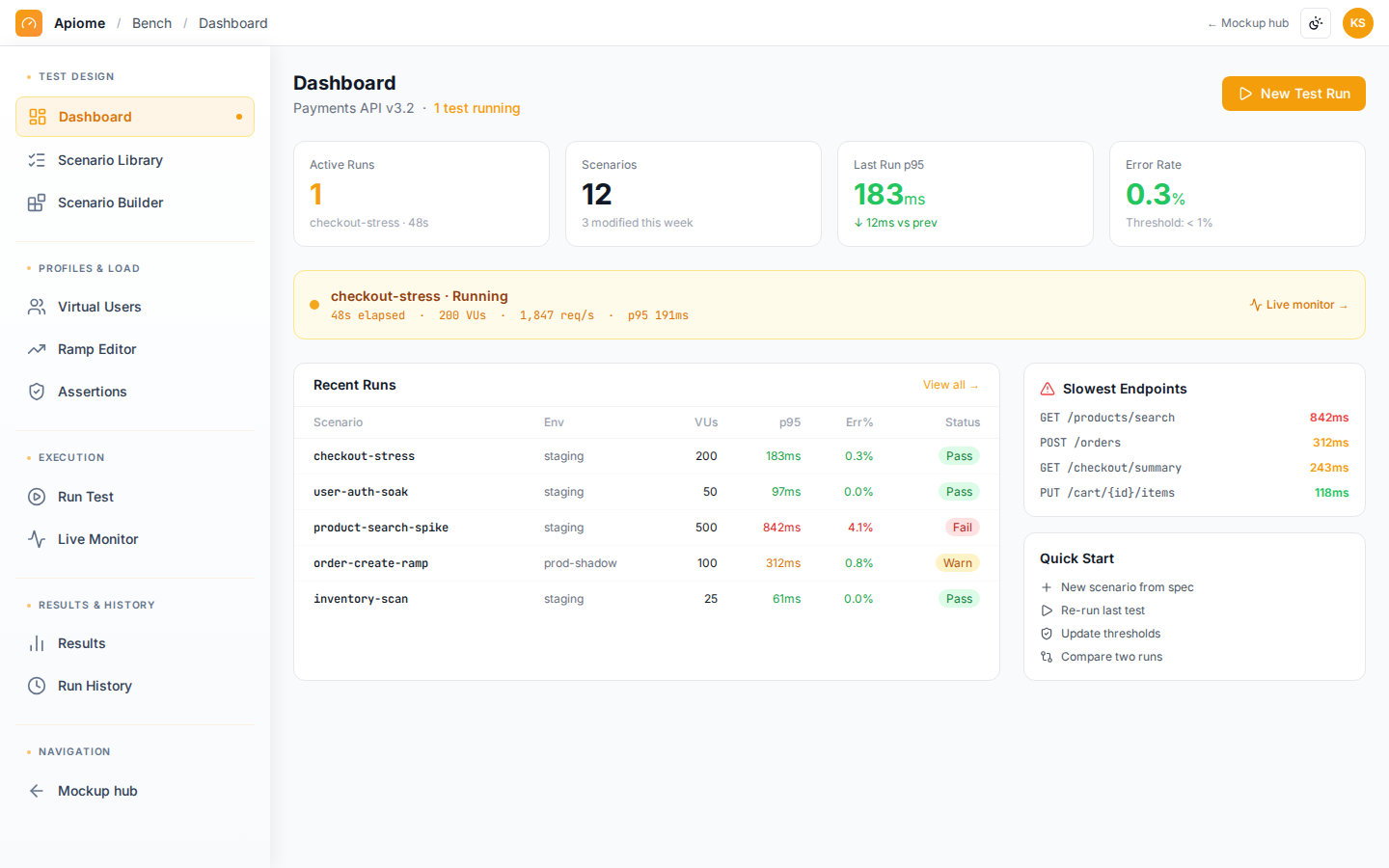
Live design previews from the Bench mockup pack — 10 surfaces in total.
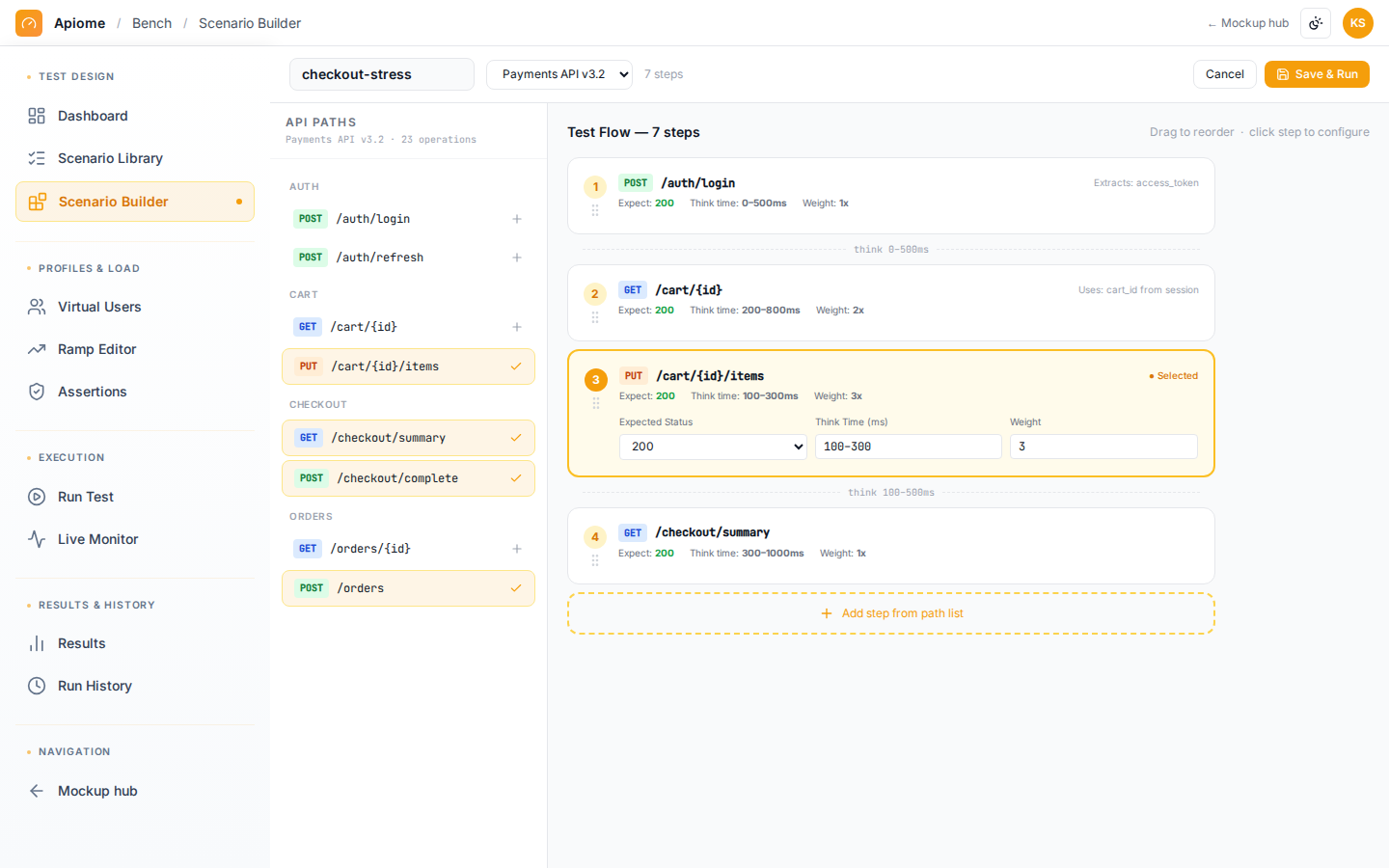
The Scenario Builder: compose multi-step test flows against a selected API schema, picking endpoints from the path tree.
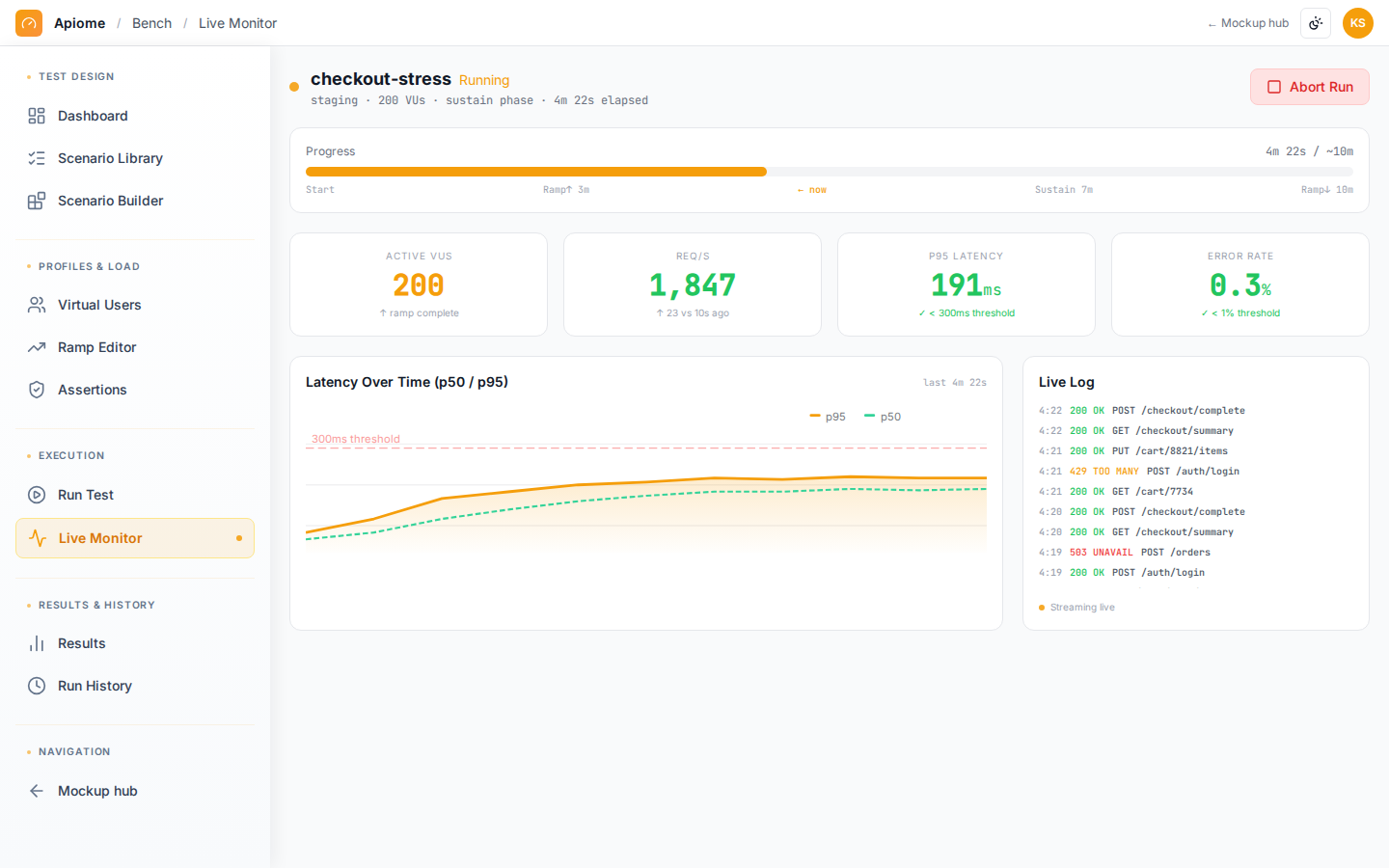
The Live Monitor streams a run in flight — virtual users in the sustain phase with real-time throughput, error rate, and latency, plus one-click abort.
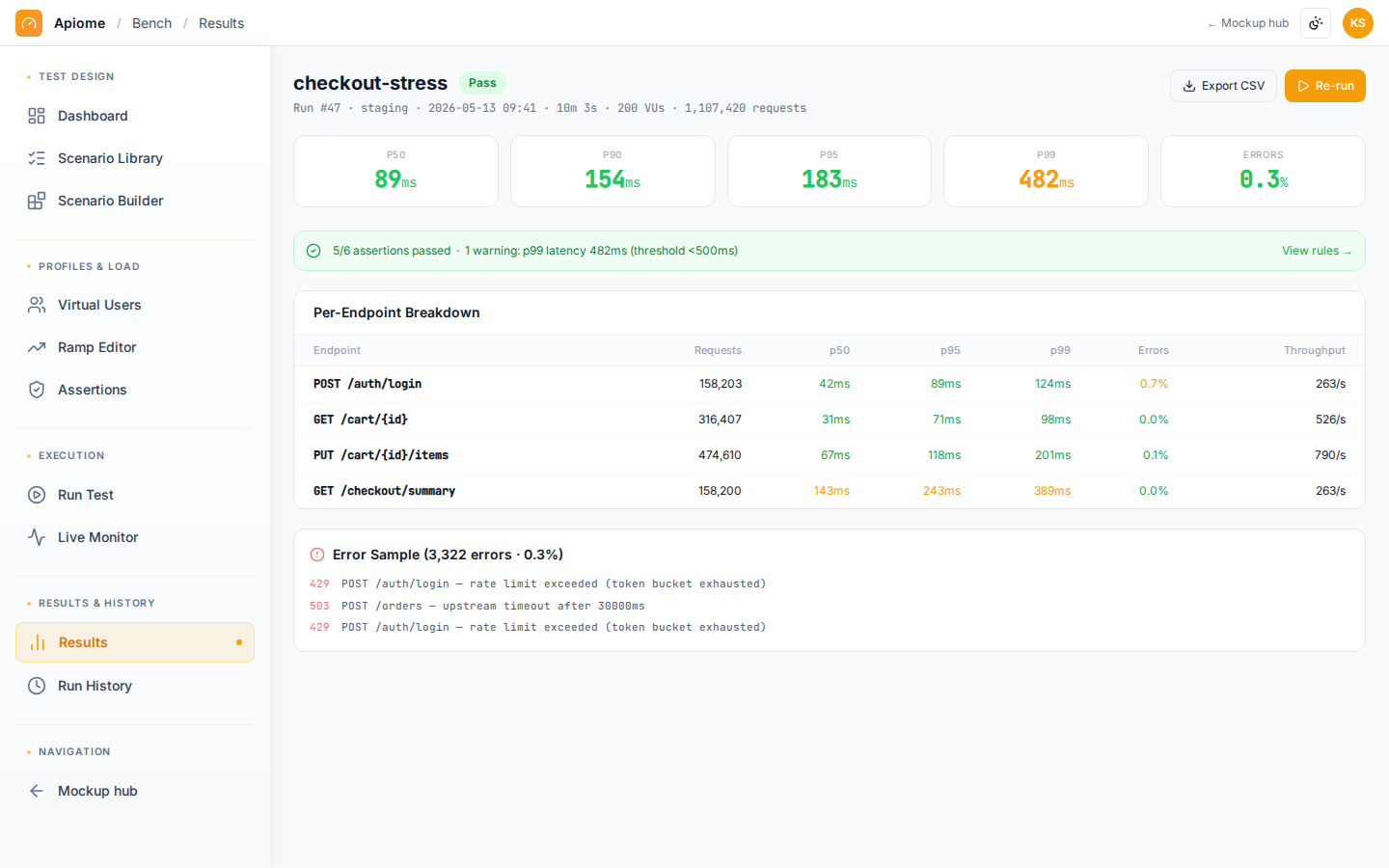
The Results view for a completed run: over a million requests summarized with a per-endpoint breakdown of requests, errors, and throughput.
Use cases
Bench is designed around the way real teams actually work — not the way a tool wants them to work.
Build multi-step load scenarios from existing API schemas in minutes and watch RPS, error rate, and latency percentiles stream live as the test ramps.
Run breakpoint analysis before peak season and plan capacity with concrete numbers instead of guesswork.
Gate deployments on performance: compare the release candidate against the latency baseline in CI and block merges on regressions.
- Isolated Docker execution for every test run, so concurrent tests never interfere
- CI/CD integration for GitHub Actions, GitLab CI, and Jenkins via REST API, webhooks, and CLI exit codes
- Full run history with metric timeseries retained for historical comparison and audit
- Scheduled report generation with configurable branding and email distribution
- Regression and breakage notifications that alert owning teams the moment a threshold is crossed
- Semantic payload generation that infers realistic values from field names, at load-test volume
- Coherent object generation where related fields stay logically consistent across millions of requests
- Capacity recommendations synthesized from observed breakpoints, in plain language
- Failure mode analysis that scores mutation detection and fault tolerance after every chaos run
AI that generates your traffic and reads your results
Bench pairs rule-based constraint solving with AI-powered semantic generation, so load tests run on data that looks like production — and finishes each run with analysis a human would write.
Every BenchAI feature is grounded in your tenant's data, runs under your data-residency policy, and respects every role and ACL the platform enforces.
Every surface in Apiome Bench
A look at the 10 screens designed for this suite — covering everything from day-1 onboarding to day-100 operations.