Apiome Sync
Every schema, every region, every environment — always in agreement.
Apiome Sync keeps schemas, instances, and environments consistent across geographies, teams, and toolchains. A CRDT-based sync engine merges concurrent edits without data loss, an active-active replication mesh keeps every region read-write, and a governed promotion pipeline moves schemas from dev to production with approval gates, drift detection, and one-click rollback.
Apiome Sync will also be featured on api-db.dev — our brand-new home for Database and ETL offerings. api-db.dev is coming soon.
What ships with Sync
Every Sync surface is wired into the rest of the Apiome platform — no glue code, no separate identity, no bolt-on integrations.
CRDT sync engine
Conflict-free replicated data types guarantee convergence: concurrent edits merge automatically — no last-writer-wins data loss.
Visual conflict resolution
A split-view interface presents both peers' changes alongside the merged result; resolutions propagate instantly to every connected peer.
Active-active multi-region replication
Every region is a read-write primary with at-least-once propagation, region-aware routing, and sub-50ms edge-cached reads.
Environment promotion with approval gates
Move schemas through dev, staging, and production with pre-promotion checks, breaking-change flags, and enforced sign-off.
Continuous drift detection
Scheduled comparisons catch unauthorized changes the moment an environment diverges — accept, revert, or investigate from the alert.
External system connectors
Bi-directional sync with Git, database DDL, and ORM models, plus CI/CD hooks that block deployments on schema drift.
A look inside Apiome Sync
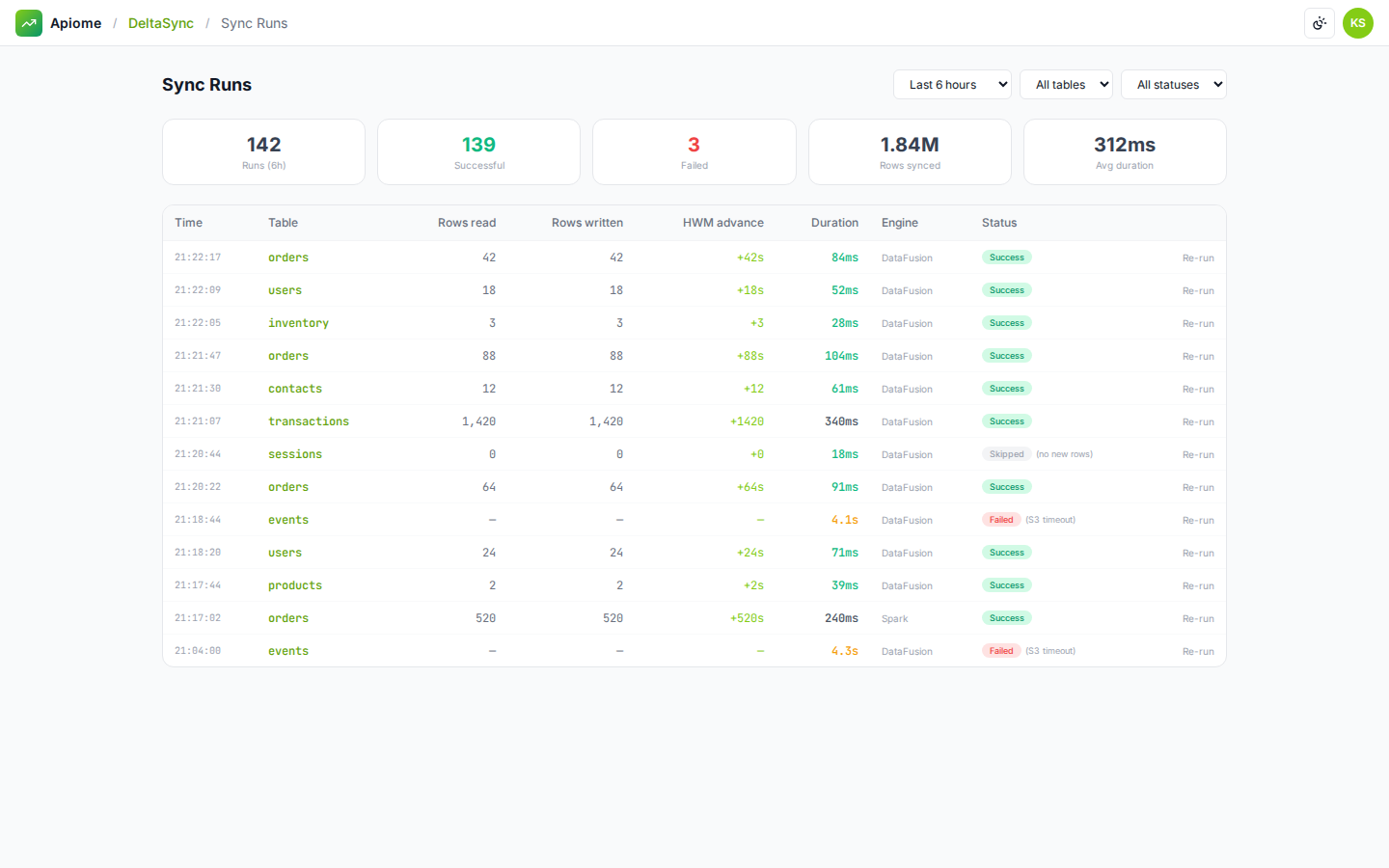
Live design previews from the Sync mockup pack — 8 surfaces in total.
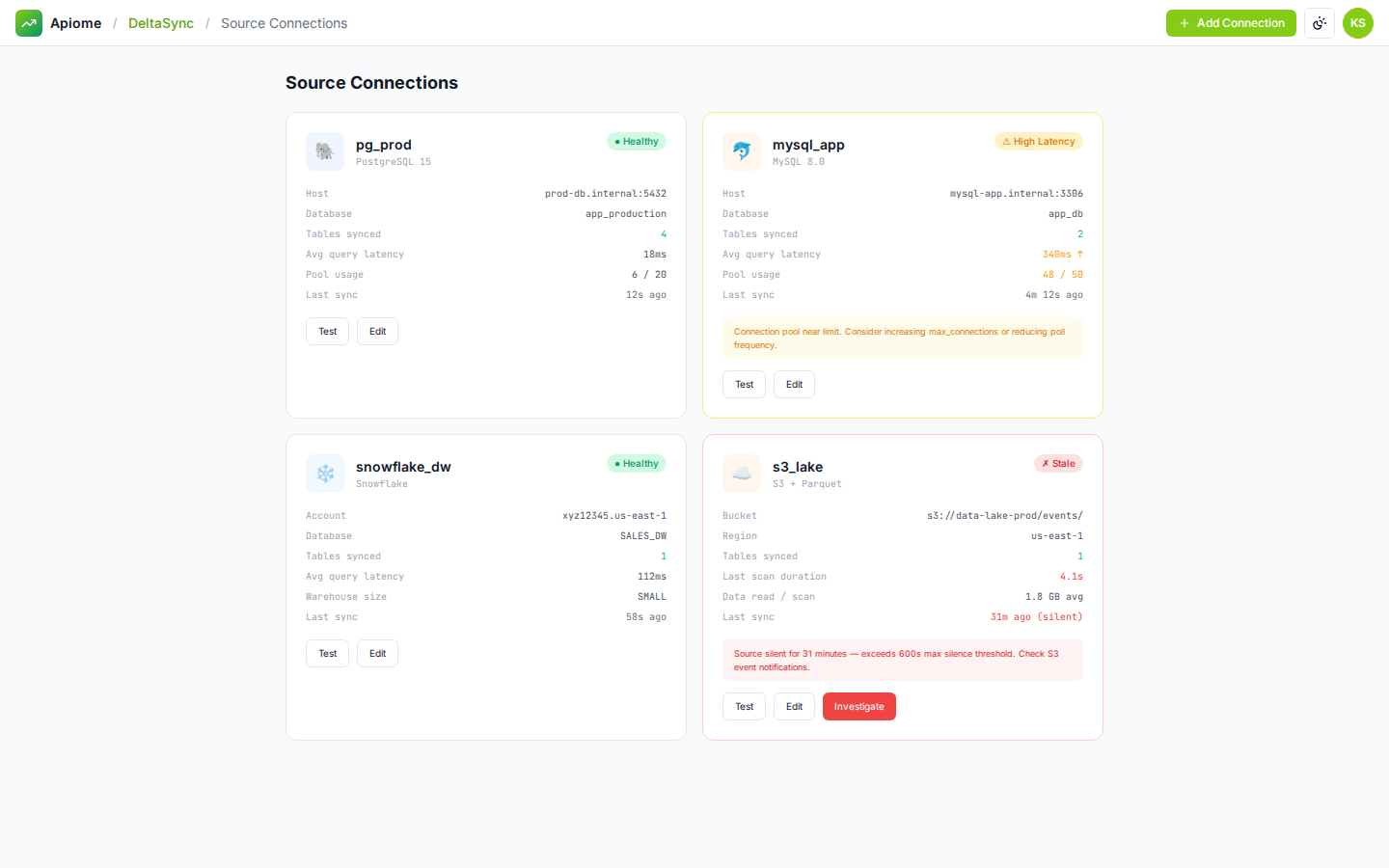
Source Connections puts every configured endpoint on one screen — connection cards with live health status and a one-click add flow.
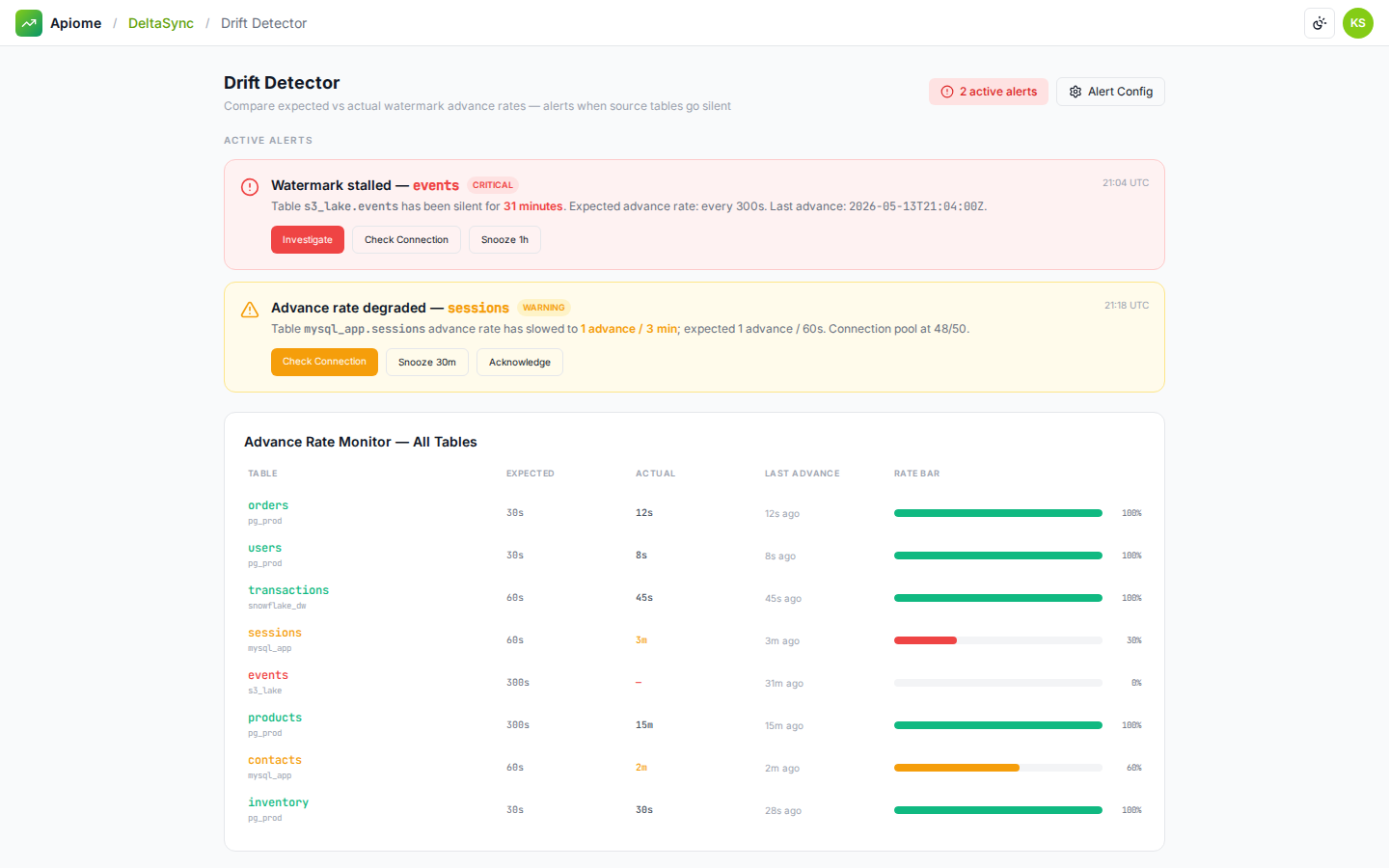
The Drift Detector continuously compares expected and actual sync advance rates and surfaces active alerts when a source goes silent.
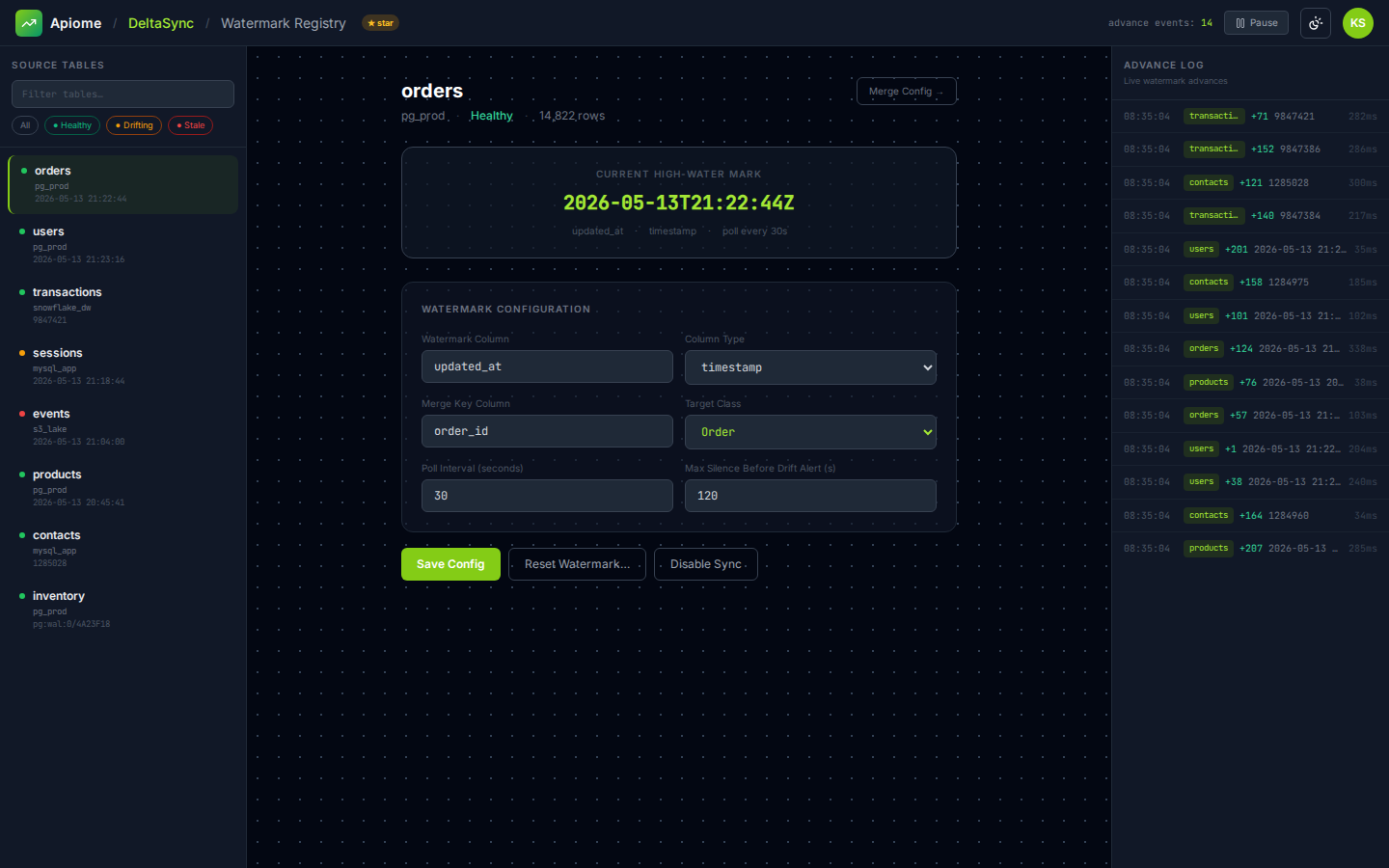
The Watermark Registry's three-pane console tracks every source table's sync position in real time, with advance events streaming live.
Use cases
Sync is designed around the way real teams actually work — not the way a tool wants them to work.
Engineers on three continents edit the same schema simultaneously — the CRDT engine merges their work in real time with no locking and no lost edits.
The promotion pipeline runs breaking-change checks and collects approvals; if anything goes wrong, point-in-time rollback restores state in seconds.
Someone hot-fixes production directly — drift detection flags it within the next scan and offers a one-click revert, with a full audit trail.
- Append-only sync event log with correlation IDs and configurable per-tenant retention
- Configurable approval gates per environment with recorded approver identities and decisions
- Encrypted credentials for every connector — secrets are never returned in API responses
- Cross-region conflict policies with region priority, field-level rules, and escalation
- CSV and JSON export of the complete promotion, rollback, and drift history for compliance
- Suggests conflict resolutions by analyzing both peers' intent, schema constraints, and prior patterns
- Diagnoses drift by correlating detected changes with the sync event log to identify the source
- Flags replication anomalies — lag spikes, rising conflict rates, silent sources — before thresholds breach
- Assesses promotion risk by scoring breaking-change impact against downstream consumers
Conflict resolution with judgment built in
Apiome Sync's intelligence layer reads the context around every conflict, drift event, and promotion — so the routine cases resolve themselves and the hard cases arrive with a recommendation attached.
Every SyncAI feature is grounded in your tenant's data, runs under your data-residency policy, and respects every role and ACL the platform enforces.
Every surface in Apiome Sync
A look at the 8 screens designed for this suite — covering everything from day-1 onboarding to day-100 operations.